In this guide
Buy a mower that's too small and every Saturday turns into a two-hour walk. Buy one that's too big and you've paid for a machine that won't fit through the gate or around the flower beds. The right size comes down to how much grass you actually mow, then a few practical checks.
The figures below come from manufacturer and retailer buying guides (Briggs & Stratton, Husqvarna, Exmark, Bobcat, Cub Cadet, Tractor Supply and Lowe's). They don't agree exactly, so where they differ we give the range rather than pick one number.
How big is my lawn, really?
Start with the area you mow, not your lot size. A quarter-acre lot with a house, driveway and patio might only have a few thousand square feet of grass.
- Sketch the lawn as a few rough rectangles (front, back, side strips).
- Measure the length and width of each in feet and multiply.
- Add the areas together.
- Divide by 43,560 to convert square feet to acres.
| Square feet of grass | Acres (approx.) |
|---|---|
| 5,000 | 0.11 |
| 10,900 | 1/4 |
| 14,500 | 1/3 |
| 21,800 | 1/2 |
| 32,700 | 3/4 |
| 43,560 | 1 |
| 87,120 | 2 |
Which type of mower fits my yard size?
This is the decision that matters most. Mower type sets how fast you can cover ground and how much effort it takes.
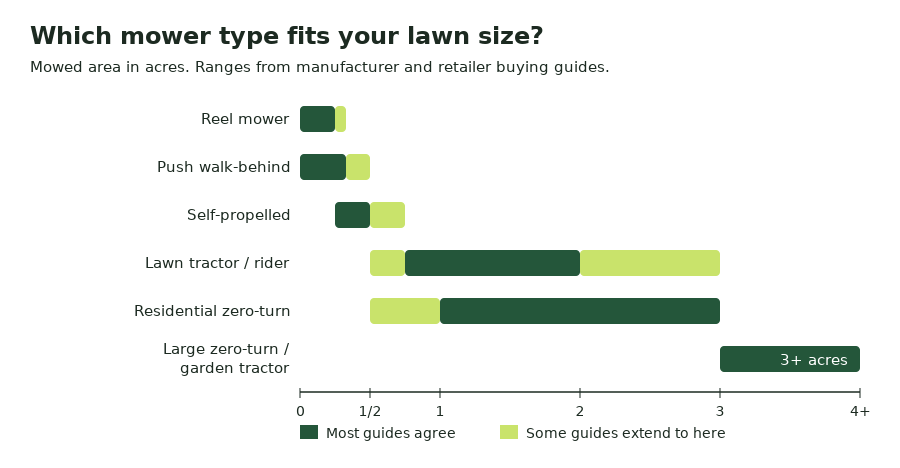 Lighter bands show where brands' recommendations overlap or differ. Pick by your mowed area, then adjust for terrain.
| Mower type | Lawn size brands recommend | Typical deck width |
|---|---|---|
| Reel (manual) | Under 1/4 to 1/3 acre, small and flat | Narrow |
| Push walk-behind | Up to about 1/3 to 1/2 acre | 20–22 in |
| Self-propelled walk-behind | Up to about 1/2 to 3/4 acre | Similar to push models; wide-area models 23–33 in |
| Rear-engine rider or mini rider | Smaller properties from about 1/2 acre, tight gates and storage | About 30 in |
| Lawn tractor | About 3/4 to 2 acres | 42–48 in common |
| Residential zero-turn | About 1 to 3 acres (Bobcat says from 1/2 acre) | 38–54 in |
| Large zero-turn or garden tractor | 3 acres and up | 44–60 in and wider |
A few notes on where the brands draw the lines:
- Walk-behind vs riding. Exmark says most guides put the switch at about 1/4 acre of mowed area, while Briggs & Stratton says riders are best above 3/4 acre and Lowe's says a push mower can handle up to an acre. In practice, under 1/4 acre a rider is rarely worth it, and above 3/4 acre walking gets old fast. Between those, it's about your budget, fitness and time.
- Self-propelled. Lowe's and Husqvarna point to self-propelled mowers once a lawn passes about 1/2 acre or has hills. Rear-wheel drive gives better traction on slopes; front-wheel drive is easier to tip up and turn around obstacles.
- Zero-turns. Bobcat says zero-turns are most efficient on properties of at least half an acre, and Cub Cadet calls them ideal from one acre up. Below that, a walk-behind is usually the better buy.
What deck width do I need for a riding mower?
Once you know you want a rider, deck (cutting) width decides how many passes you make. Wider decks finish open lawns faster but cost more.
| Mowed area | Deck width suggested |
|---|---|
| Under 1 acre | About 30–42 in (30 in mini riders for tight spaces) |
| 1 to 1.5 acres | 42 in is a common starting point |
| 1.5 to 2 acres | 42–52 in |
| 2 to 3 acres | 42–54 in |
| 3 to 4 acres | 52–60 in |
| 4+ acres | 60 in and up |
For a sense of time, Exmark estimates that a 42-inch deck on a standard garden tractor mows about one acre in roughly an hour. Tractor Supply describes its own size bands (up to 2 acres: 21 to 52 inches; 2 to 3 acres: 52 to 54 inches; 3 to 4 acres: 54 to 60 inches) as good starting points, not rules.
When should I go smaller than the chart says?
Acreage is only the first filter. Size down, or choose a different type, when any of these apply:
- Lots of trees, beds and play equipment. Exmark suggests a smaller deck with a stronger engine for cluttered or hilly lots. A 60-inch deck spends a lot of time backing up around obstacles.
- Narrow gates or paths. Measure every gate the mower has to pass through. Bobcat recommends a few inches of clearance on each side of the deck and discharge chute. A mini rider or a wide walk-behind may be the only thing that fits.
- Storage space. Measure the garage or shed spot, including room to walk around the mower. Some walk-behinds fold or store upright.
- Hills and slopes. Steep ground is a safety issue, not just a traction one. Check the maximum slope in the owner's manual of any rider you're considering, and mow steep banks with a walk-behind or string trimmer instead.
Gas or battery: does yard size change the answer?
Brands list both gas and battery models in most size classes, and none of the guides we reviewed gives a firm acreage cutoff for battery mowers. What decides it is runtime. Lowe's notes that battery voltage relates to power and amp-hours to runtime, so for a larger lawn, compare the stated runtime against how long your mowing actually takes, or plan on a second battery. Corded electric mowers only make sense for small yards because the cord limits your reach.
Mistakes to avoid when choosing mower size
- Using lot size instead of mowed area, which leads to overbuying.
- Buying the widest deck "to be safe" without measuring gates and storage.
- Choosing a plain push mower for a hilly half acre. Self-propelled rear-wheel drive is worth it there.
- Judging a zero-turn only by speed. On a small, cluttered lawn, the turning advantage matters more than deck width.
- Forgetting upkeep. Bigger machines mean more blades, belts and tires to maintain. Every gas mower needs end-of-season care; see how to winterize a lawn mower before your new one goes into storage.
If your current mower is the right size and just giving you trouble, a repair may be cheaper than a replacement. A broken starter rope, for example, is a common fix: how to fix a lawn mower pull cord.
Common questions
Is a 42-inch mower big enough for 1 acre?
Yes. Several manufacturers name a 42-inch deck as a good starting point for about 1 to 1.5 acres, and Exmark estimates a 42-inch garden tractor mows about an acre in roughly an hour. Go wider only if the lawn is open and you have room to store and move the mower.
Can I use a push mower on a half-acre lawn?
You can, but it is near the upper limit most brands suggest for a plain push mower. A self-propelled model, or a wider walk-behind, makes a half acre much less tiring, especially if the yard has any slope.
Is a bigger mower deck always better?
No. A wider deck cuts more grass per pass on open ground, but it costs more, is harder to steer around trees and beds, may not fit through your gate and needs more storage space. On a small or cluttered lawn, a narrower deck can finish just as fast.
How do I measure my lawn's size?
Measure the length and width of each grassy area in feet, multiply them, and add the results, leaving out the house, driveway and beds. Divide the total by 43,560 to get acres. Your property records give lot size, but the mowed area is usually smaller.
Sources
- Choosing a Lawn Mower, Briggs & Stratton
- How to Choose a Lawn Mower & Buying Guide, Husqvarna
- What to Know About Riding Lawn Mower Deck Size (Cutting Width), Tractor Supply Co.
- What Size Mower is Right for Your Lawn?, Exmark
- What Size Zero-Turn Mower is Right for Me?, Bobcat Company
- The Ultimate Cub Cadet Lawn Mower Buying Guide, Cub Cadet
- Lawn Care 101: Choosing the Best Lawn Mower for Your Needs, Lowe's
Lawn conditions vary by region, grass type and soil. For product applications, the label is the law; for tricky problems, your local cooperative extension office can test soil and identify diseases.